Home Boiler repair Guide
What pressure should a boiler be?
Most combi and system boilers should read between 1 and 1.5 bar with the heating off. If yours is outside that, here’s whether to worry, how to fix it yourself and when to stop.
If you’re wondering what pressure a boiler should be, the answer for most UK combi and system boilers is between 1 and 1.5 bar when the heating is off. It rises a little when the heating runs. The gauge is on the front of the boiler, sometimes behind a flap, or underneath on some older models, and most have a green zone marking the normal range.
At a glance
| Reading | What it means | What to do |
|---|---|---|
| Below 1 bar (cold) | Too low. The boiler may lock out with a fault code. | Top up with the filling loop. |
| 1 to 1.5 bar (cold) | Normal | Nothing |
| Around 2 bar (heating on) | Normal. Water expands as it heats. | Nothing |
| Above 2 bar (cold) | Too high | Bleed a radiator to let some water out. |
| Keeps dropping or rising | A leak or a faulty part | Call a Gas Safe registered engineer. |
What pressure should a boiler be?
Manufacturers agree on the cold figure. Ideal, Vaillant and Worcester Bosch all tell owners to fill to between 1 and 1.5 bar, and British Gas gives the same range for a boiler that’s switched off. Baxi, Ideal and Which? describe the wider operating range as 1 to 2 bar.
So what should boiler pressure be when the heating is off? Aim for 1 to 1.5 bar. When the heating is on, British Gas says around 2 bar is fine. The water expands as it warms, which pushes the needle up, and it should settle back once the system cools.
Your own boiler’s manual is the final word. Some gauges have two marker needles showing the range set when it was installed. Check the reading when the boiler has been off for a while, because a cold reading is the one to compare.
This only applies to sealed systems, which is what most combis and system boilers use. If you have an older open-vented system with a small feed tank in the loft, there’s no pressure gauge to watch.
Is low boiler pressure dangerous?
No. Which? and Ovo Energy both say low pressure isn’t dangerous in itself. The boiler is designed to protect itself: when the pressure is too low, it stops firing and shows a fault code rather than running unsafely. That’s why low pressure usually shows up as no heating or no hot water.
What matters is the cause. Which? warns that the cause of low pressure can damage the system if it isn’t fixed. A one-off drop after bleeding radiators is nothing to worry about. Pressure that drains away again within days points to a leak, and water escaping from pipes under a floor or inside the boiler needs finding before it does damage.
Low water pressure is a different thing from a gas problem. If you smell gas or see signs of carbon monoxide, such as sooty marks around the boiler or a flame that keeps going out, leave the pressure alone, turn off the gas if you can, and call the National Gas Emergency number on 0800 111 999.
Why boiler pressure drops
- You’ve bled the radiators. Water escapes with the air, so the pressure falls. Ovo calls this the most common cause of a sudden drop. See our guide to central heating for bleeding steps.
- The heating has been off for a long time. Which? lists this as a cause. A small loss over the summer is normal.
- A leak. Look for damp patches or drips around radiators, valves, towel rails and under the boiler. Some leaks are hidden under floorboards.
- A faulty part. Ideal says frequent top-ups may point to a faulty pressure relief valve. A failing expansion vessel can also make the pressure swing.
How to increase boiler pressure safely
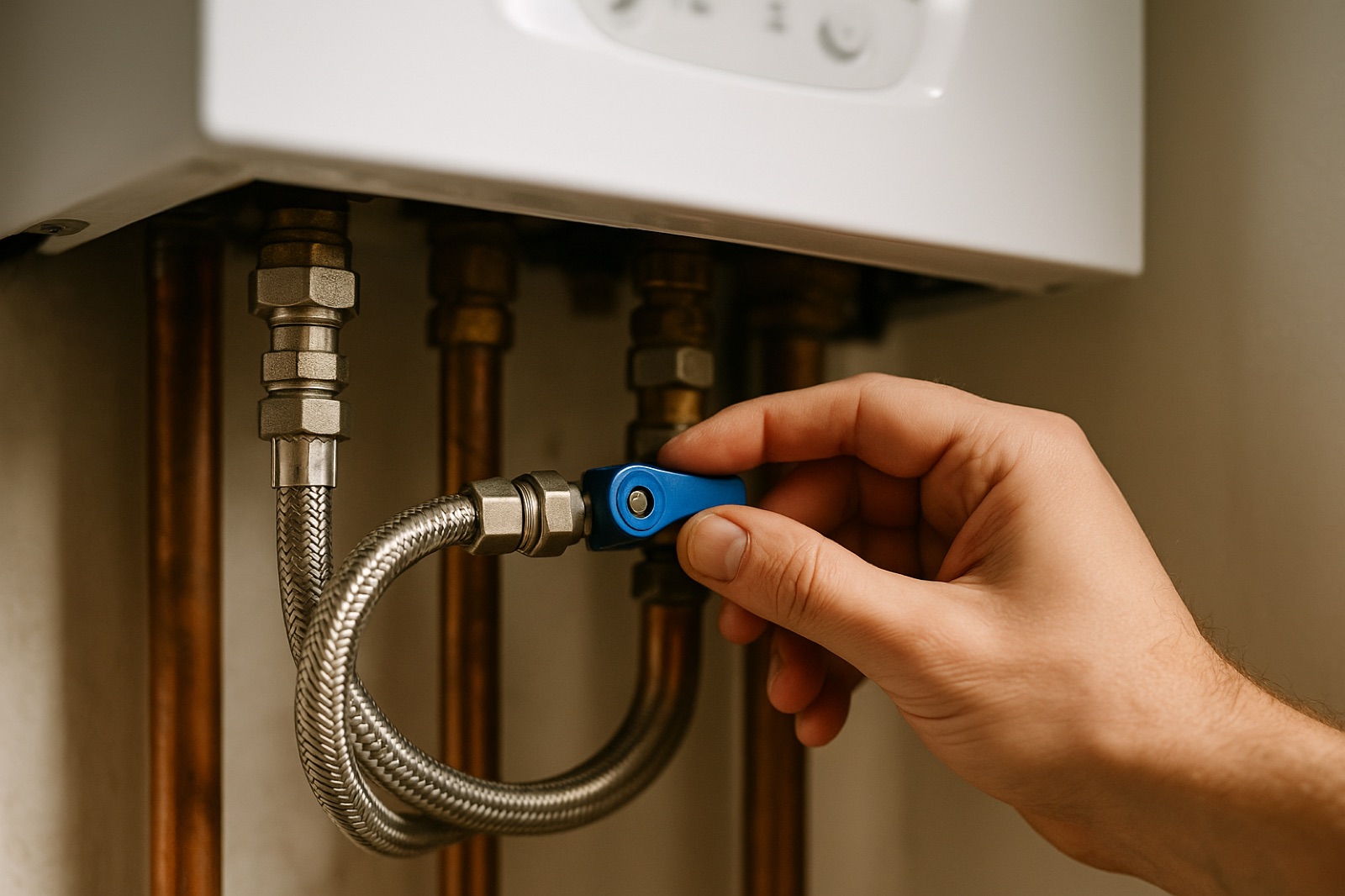
Topping up the pressure is a normal homeowner job. You add cold mains water through the filling loop, a short hose or built-in valve that links the mains to the heating system. You don’t need to open the boiler.
- Turn the boiler off and let the system cool. A cold reading is the accurate one.
- Find the filling loop. On many boilers it’s a braided silver hose under the boiler with a valve at one or both ends. Some Worcester Bosch models have a blue lever you pull down, or a key that slots into the underside. If you can’t clearly identify it, check your manual. Don’t turn valves you aren’t sure about.
- Open the valve slowly. If there are two, open the first fully, then open the second slowly. You’ll hear water running in. Watch the gauge the whole time, as it can climb quickly.
- Close it between 1 and 1.5 bar. Shut both valves fully. A valve left slightly open will keep pushing the pressure up.
- Switch the boiler back on and reset it if it shows a fault. Check the loop for drips.
- Check the gauge again over the next few days to see whether it holds.
If you’ve overfilled, bleed a radiator into a cup to let a little water out, then recheck.
Boiler pressure rising or too high
A rise while the heating is on is normal. A reading above 2 bar when the system is cold is too high, according to Which? and Worcester Bosch. Vaillant advises not letting it go above 2.5 bar.
Common reasons the boiler pressure keeps rising:
- The filling loop wasn’t closed fully after a top-up, so mains water keeps seeping in.
- The system was overfilled.
- The expansion vessel, which absorbs the extra volume as water heats, has lost its air charge.
- The pressure relief valve is faulty.
First, check the filling loop valves are fully shut. Then, with the heating off and cool, bleed a radiator to bring the pressure down to the normal range. If it climbs again, the expansion vessel or relief valve needs an engineer. Baxi notes that when pressure gets too high, the relief valve may release water, which you might see dripping from a copper pipe outside.
When to call an engineer
Stop and call a Gas Safe registered engineer if:
- You need to top up more than once or twice a year. Ideal says topping up monthly or more often suggests a leak or faulty valve.
- The pressure drops to zero, or falls again within days of a top-up.
- The pressure won’t rise when you open the filling loop, or keeps rising after you’ve closed it.
- You can see water leaking from the boiler, pipes, valves or radiators.
- High pressure doesn’t come down after bleeding a radiator.
- The fix would mean taking the casing off. Baxi says only a Gas Safe registered engineer is legally qualified to remove it.
If you’re weighing a repair against a replacement, our boilers hub covers the options.
Questions people ask
What should boiler pressure be when the heating is off?
Between 1 and 1.5 bar on most sealed systems. That’s the range Ideal, Vaillant, Worcester Bosch and British Gas give. Check your manual for your exact model.
Is 2 bar too high?
Not while the heating is running. British Gas says around 2 bar is normal when the boiler is on. If it reads above 2 bar when the system is cold, bleed a radiator to bring it down.
Can I use my boiler with low pressure?
Usually it won’t let you. Below 1 bar, many boilers stop and show a fault until you top up. Low pressure isn’t dangerous, so topping up and resetting is safe to do.
How often is it normal to top up boiler pressure?
Ideal says once or twice a year is generally fine. If you’re doing it every month or more, there’s likely a leak or a faulty part.
Sources
- Ideal Heating: Topping up boiler pressure
- Vaillant: Repressurising a boiler
- Worcester Bosch: Maintaining your boiler pressure (fact sheet, PDF)
- Baxi: Why is my boiler pressure high?
- Baxi: Top tips for maintaining your boiler
- British Gas: How to bleed a radiator
- Which?: What should your boiler pressure be?
- Baxi: What to do if you can smell gas
- Ovo Energy: What to do if your boiler pressure is too low
- Viessmann: What to do if your boiler pressure is too high