Home Damp and mould removal
Damp and mould removal
Professional mould removal costs about £150 for a single wall and £725 to £1,100 for a whole house. The cleaning is the easy part. Keeping it away means finding why the wall is wet.
Mould removal has two parts. First the growth is cleaned off and the surface treated so spores don’t take hold again straight away. Then the cause is found and fixed, because mould only grows where something keeps a surface damp. Skip the second part and you will be scrubbing the same corner again in a few weeks.
We don’t send our own team. Describe the problem and we pass your request to damp and mould specialists who cover your postcode, so you can compare what they find and what they charge.
What causes mould in UK homes
Nearly every case comes down to one of three kinds of damp:
- Condensation. Warm, wet air from cooking, showers, drying clothes and breathing hits a cold surface and turns to water. It is by far the most common cause. Look for mould in ceiling corners, behind furniture on outside walls, around window reveals and on the windows themselves, worst in winter.
- Penetrating damp. Water gets in from outside through a leaking gutter, cracked render, failed pointing, a blocked cavity or a roof defect. It shows as a patch that grows after rain, often on one wall only and at any height.
- Rising damp. Ground water drawn up into a wall because the damp proof course has failed or been bridged by a raised path or flower bed. It sits low on the wall, often with a tide mark and salts. It is much rarer than many sales pitches suggest.
Plumbing leaks are the fourth culprit: a weeping pipe under a bath, a leaking shower tray or a slow drip behind a kitchen unit. If a patch appears suddenly in a room with no outside wall, suspect a leak first.
Why it matters for your health
GOV.UK guidance for housing providers says damp and mould can cause or worsen breathing problems, infections, allergies and asthma, and can affect the immune system. Babies and young children, older people, and anyone with a lung condition or a weakened immune system are most at risk. If someone in your home falls into one of those groups, don’t wait for the problem to spread.
What a professional mould removal visit involves
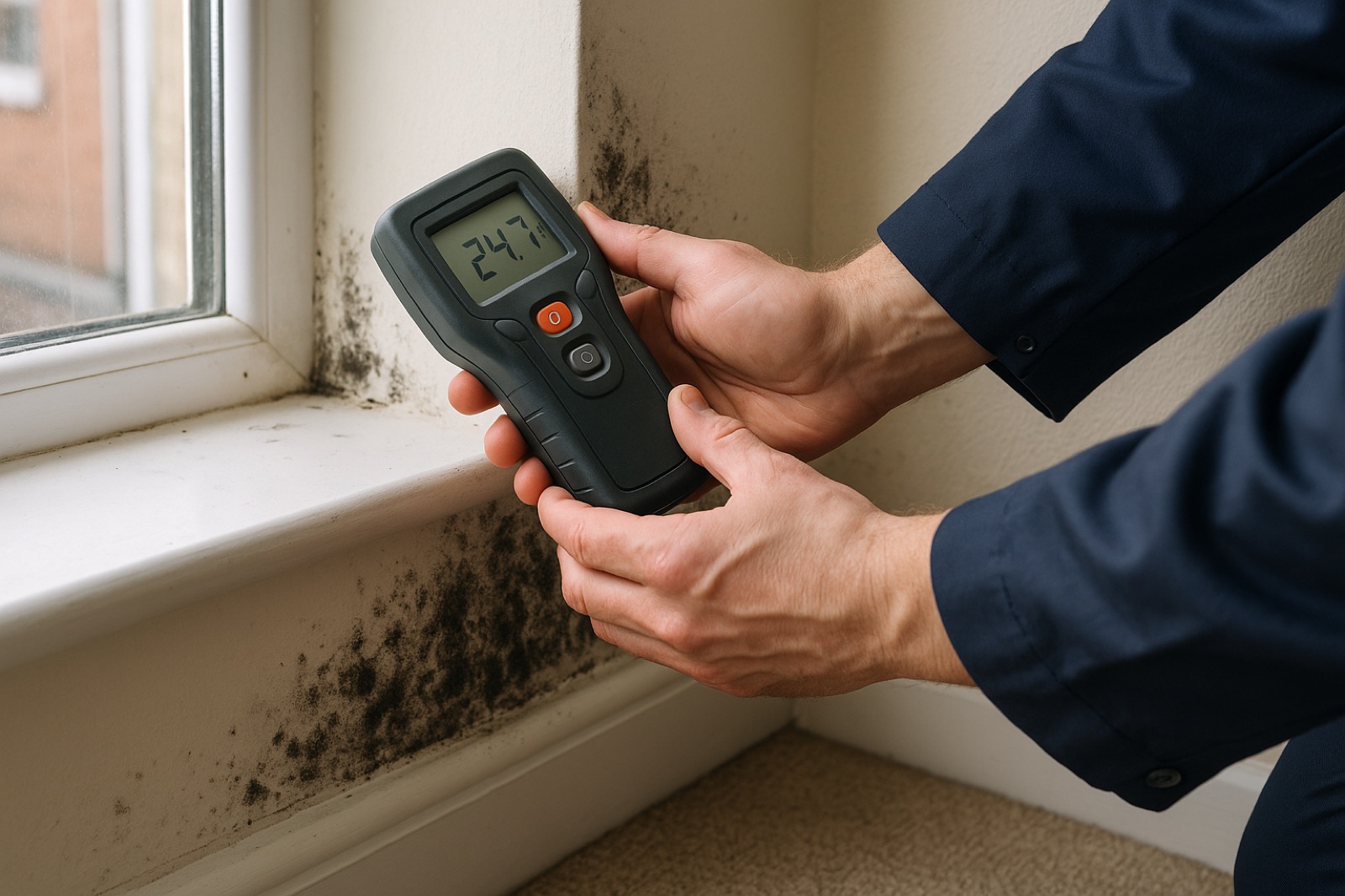
- Inspection. The specialist looks at where the mould is, takes moisture readings, checks humidity and looks for leaks, failed gutters, blocked air bricks and broken fans. MyJobQuote puts an inspection at £150 to £300.
- Diagnosis. They tell you which kind of damp is behind it and what fixes it. Get this in writing.
- Containment and cleaning. For larger areas, the room is sealed off, the mould is treated with a fungicidal wash and allowed to work, and contaminated materials such as soft furnishings or ruined plaster are bagged and removed.
- Making good. Damaged plaster is repaired and the area painted with a mould-resistant finish once it is dry.
- Fixing the cause. That might be an extractor fan, PIV unit, a repaired gutter or a plumbing repair, often by a different trade.
A small room can be done in a day. MyJobQuote says larger jobs take one to five days, with longer if plaster has to dry out before it is decorated.
Clean it yourself or call a specialist?
Small patches of surface mould on paint, tiles or sealant can usually be cleaned safely at home. Our guide to removing mould from walls covers how to do it without spreading spores, and why bleach and vinegar disappoint. Call a professional if:
- the mould covers a large area, or several rooms
- it comes back within weeks of a thorough clean
- plaster is soft, wallpaper is lifting or there is a musty smell you can’t find
- someone in the home has asthma, a lung condition or a weakened immune system
- you rent and need written evidence of the cause for your landlord
Stopping mould coming back
If condensation is the cause, the fix is less moisture in the air and fewer cold surfaces. That usually means:
- an extractor fan in the bathroom and kitchen that actually vents outside and runs on after you leave the room
- trickle vents open on windows, especially after new double glazing
- steady, low background heating rather than a cold house warmed in short bursts
- furniture pulled a few centimetres off outside walls
- whole-house ventilation such as PIV where fans alone aren’t enough
See ventilation installation for fans, PIV and MVHR, and how to stop window condensation for daily habits. Cheap damp traps and crystal pots soak up very little. Which? describes them as suited to low-level problems only. If cold walls are the issue, better heating controls or insulation may be part of the answer, and our heating engineers page covers getting radiators working properly.
Be wary of damp proofing upsells
A common worry is being sold expensive chemical injection or tanking for what turns out to be condensation. Before you agree to structural damp proofing, ask:
- Which type of damp is it, and what evidence shows that?
- Were readings taken with more than a surface moisture meter? Those meters can read high on salts and on some wall materials.
- Have outside causes such as gutters, high ground levels and blocked air bricks been ruled out?
- Is the surveyor independent of the firm selling the treatment?
If you get a recommendation for major work, a second opinion from an independent surveyor is cheap compared with the job.
If you rent: landlord duties and Awaab’s Law
Landlords are responsible for damp and mould caused by the building, such as leaks, broken or missing extractor fans, poor insulation and heating that doesn’t work. Cooking, bathing and drying clothes are normal everyday use, and a leaflet about lifestyle changes doesn’t replace a repair.
In England, Awaab’s Law has applied to social landlords since 27 October 2025. They must investigate significant damp and mould within 10 working days of being told, send the tenant written findings within three working days of the inspection, and make the home safe within five working days after that. The government has said it will extend the law to private renting through the Renters’ Rights Act. Private landlords must still keep homes fit to live in.
Report mould in writing with dated photos. If nothing happens, contact your council’s environmental health team, which can inspect and take action against serious hazards.
Comparing mould removal quotes
- Does it name the cause, not just the treatment?
- Is the area to be treated stated in rooms or square metres?
- Are containment, disposal and making good included?
- Is the fix for the cause included, or quoted separately?
- What guarantee is offered, and does it cover regrowth if the cause isn’t fixed?
A quote to clean and paint with no explanation of why the mould grew is a quote for a return visit.
Typical mould removal prices
| Job | Typical UK price | Notes |
|---|---|---|
| Mould inspection | £150 to £300 | Some firms deduct it from the treatment price |
| Single wall | £150 to £200 | Surface mould on one wall |
| Large room | £220 to £280 | Clean, treat and seal one room |
| Roof space or attic | £300 to £650 | Often linked to poor loft ventilation |
| Whole property | £725 to £1,100 | Average job about £700 |
| Black mould treatment | £250 to £1,100 | Depends on how far it has spread |
| Hard-to-reach areas | Add £50 to £200 | Ceilings, stairwells, behind fitted units |
| Repainting a small bedroom | £250 to £400 | Anti-mould paint itself is £20 to £50 a room |
Source: MyJobQuote mould removal cost guide, updated September 2026. Emergency work after flooding adds 10% to 30%.
Damp and mould removal guides
Damp and mould removal by city
Show all 50 cities as a list
England
- Birmingham
- Bolton
- Bournemouth
- Bradford
- Brighton
- Bristol
- Cambridge
- Chelmsford
- Coventry
- Derby
- Doncaster
- Exeter
- Gloucester
- Huddersfield
- Hull
- Ipswich
- Leeds
- Leicester
- Liverpool
- London
- Luton
- Manchester
- Middlesbrough
- Milton Keynes
- Newcastle
- Northampton
- Norwich
- Nottingham
- Oxford
- Peterborough
- Plymouth
- Portsmouth
- Preston
- Reading
- Sheffield
- Southampton
- Stoke-on-Trent
- Sunderland
- Swindon
- Wakefield
- Warrington
- Wolverhampton
- York
Northern Ireland
Common questions
How much does professional mould removal cost?
MyJobQuote puts the average at about £700. A single wall is around £150 to £200, a large room £220 to £280 and a whole property £725 to £1,100. An inspection on its own is usually £150 to £300.
Can I remove mould myself?
Small patches of surface mould, roughly the size of a doormat or less, can usually be cleaned with a mould remover, gloves, goggles and a mask, with the window open. Call a professional if it covers a large area, keeps returning after cleaning, has soaked into plaster, or someone in the home has asthma, a weak immune system or a lung condition.
Why does mould keep coming back after I clean it?
Because the moisture is still there. Cleaning removes the growth you can see, but the wall stays cold and damp. Until you fix the cause, whether that is condensation, a leak or damp coming through the wall, the mould grows back in the same place.
Is mould the landlord's responsibility?
Landlords must deal with damp and mould caused by the building, such as leaks, poor ventilation, broken extractor fans or inadequate heating. Social landlords in England must investigate significant damp and mould within 10 working days under Awaab's Law. Tenants are expected to use the home reasonably, but cooking, washing and drying clothes are normal use.
Do I need a damp proof course for mould?
Rarely. Most mould in UK homes is caused by condensation, which a damp proof course does nothing for. Be wary of anyone who recommends chemical injection after a quick meter reading on a wall that only shows mould in the corners. Ask what the cause is and how they tested for it.
Sources
- MyJobQuote: mould removal cost (September 2026)
- GOV.UK: understanding and addressing the health risks of damp and mould in the home
- GOV.UK: millions of tenants safe from black mould through Awaab's Law
- GOV.UK: Awaab's Law guidance for social landlords
- Which?: how to get rid of mould and prevent it
- Which?: how to stop condensation