Home Gas engineer courses
Gas engineer courses and training routes
To work on gas in the UK you need an ACS assessment and Gas Safe registration. A course alone won't get you there: every route also needs real work alongside a registered engineer.
A gas engineer course teaches you to install, service and repair gas appliances safely. But in the UK no course on its own lets you work on gas. You have to pass ACS assessments, then work for or run a business that is on the Gas Safe Register. Every sensible route builds in time on real jobs, alongside an engineer who is already registered.
This page sets out the main routes, what each costs and how long it takes, so you can pick the one that fits your age, savings and situation.
How you become Gas Safe registered
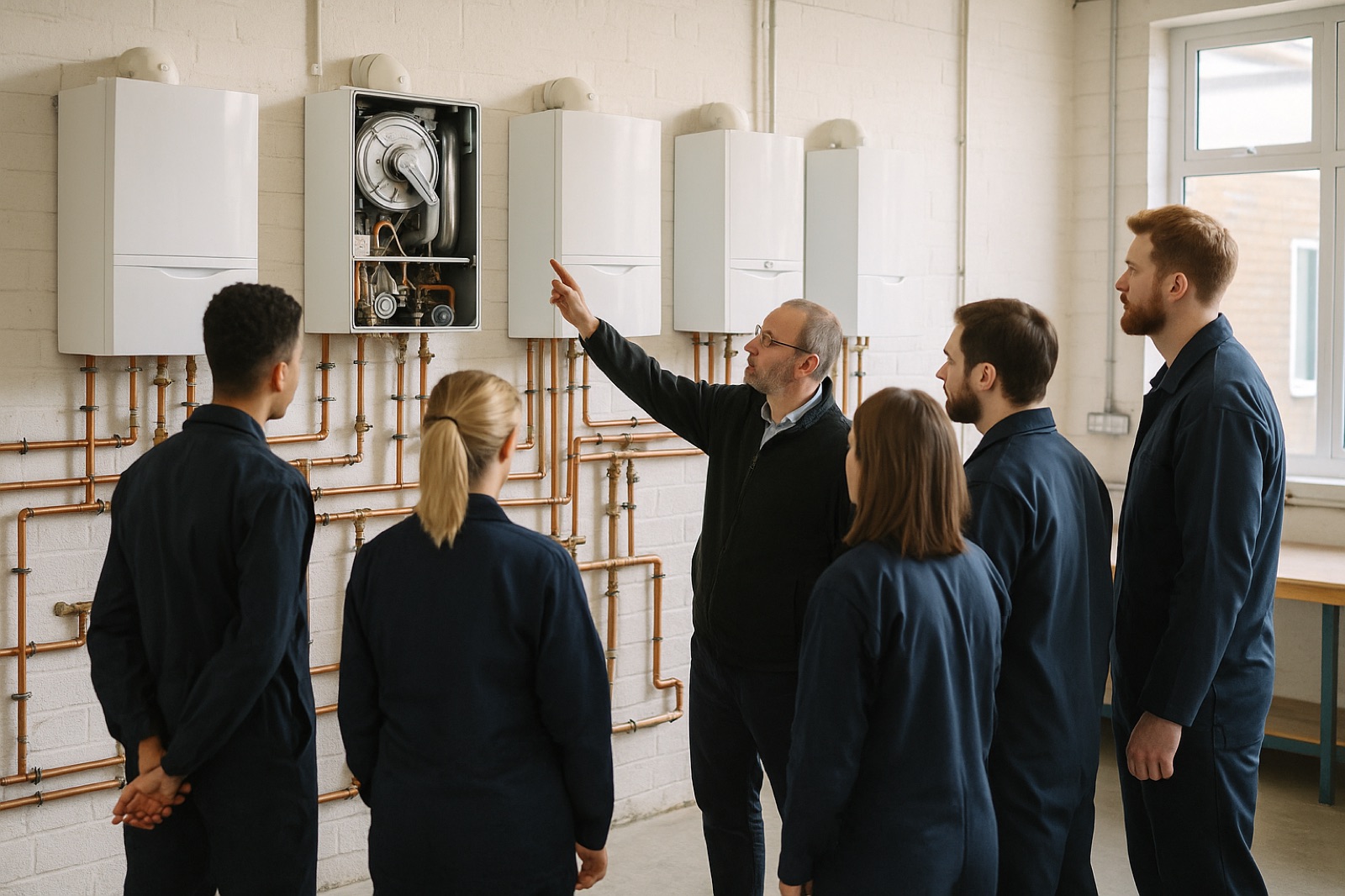
- Training. You learn gas safety, combustion, pipework, flues and appliance work, in a classroom and on site.
- A portfolio of site work. You record real jobs done under the supervision of a Gas Safe registered engineer.
- ACS assessment. You pass the core gas safety assessment (often called CCN1) and an assessment for each appliance type you want to work on, such as central heating boilers and water heaters.
- Registration. A Gas Safe registered business, which can be your own, registers you. Your ID card then lists the appliances you’re allowed to work on.
- Reassessment. You renew your ACS every five years to stay registered.
The main routes into the trade
Apprenticeship
The Level 3 gas engineering operative apprenticeship is the standard route for school leavers and younger career changers. It typically lasts 18 months, you earn a wage, and you don’t pay course fees. Training is split between college and work with your employer, so the placement problem is solved from day one. The National Careers Service says advanced apprenticeships usually ask for five GCSEs at grades 9 to 4, including English and maths.
The catch is finding an employer. Large energy and housing firms run intakes each year. Small heating firms take apprentices too, but you often have to approach them directly.
College foundation course
Colleges run gas foundation courses for adults with little or no gas experience. Burnley College lists the BPEC Domestic Gas Foundation at £3,200 for a year part time, including the portfolio and the first core assessment. You still have to find your own placement with a Gas Safe registered business before you sit ACS.
Private fast-track or managed learning programme
Private training centres sell intensive packages, often aimed at career changers in their thirties and forties. Logic4training, which sells these programmes, puts new entrant prices at about £4,000 to over £7,700 plus VAT, with its own starting at £5,495 plus VAT. Some include a placement and portfolio support. Others leave you to find both.
The common complaint is paying thousands and finishing “unconfident and under-prepared”. A short course can teach theory, but confidence comes from hours on real boilers with someone checking your work.
Already qualified in plumbing or heating
If you already hold a recognised qualification or entry route, you may only need ACS training and assessment. Shrewsbury Colleges Group lists a two-day ACS pre-assessment course at £275 for November 2026. Experienced engineers also use these courses for their five-yearly reassessment.
How to choose a course
Before you pay a deposit, ask the provider:
- How many hours are hands-on in a workshop, and how many are classroom?
- Who finds the work placement, and what happens if you can’t get one?
- Are ACS assessment fees included, and for which appliances?
- Is the portfolio supervised by the provider, or only signed off at the end?
- What’s the refund policy if you drop out?
- Can you speak to past students who now work in the trade?
Be wary of any provider that promises you’ll be “job ready” in a few weeks with no site experience. ACS assessment centres won’t accept you without the right entry route and evidence.
Pay and prospects
The National Careers Service puts gas service technicians at about £25,000 when starting, rising to £45,000 with experience, on 40 to 45 hours a week. Many engineers go self-employed once they have a few years behind them, which brings the cost of a van, tools, insurance and registration.
Some newcomers worry gas is a dying trade. The UK still has millions of gas boilers that need servicing and repair, and landlords must have gas appliances checked every year. The smart move is to add heat pump skills over time rather than pick one or the other. Read our air source heat pump guide to see what the work involves.
Other qualifications that widen your work
- OFTEC for oil-fired boilers, common in rural and off-grid homes. OFTEC lists its training courses and assessments online, and our oil boiler servicing page shows what the job involves.
- F-Gas for refrigerant work on heat pumps and air conditioning. The engineer needs a personal F-Gas qualification and the business needs company certification. F-Gas assumes refrigeration competence, so it isn’t a one-day add-on to a gas course. See our air conditioning page for how it’s used.
- Heat pump training and MCS, needed for installs that qualify for the Boiler Upgrade Scheme. Our Boiler Upgrade Scheme guide explains why customers ask for MCS.
- Unvented hot water (G3) and water regulations certificates, which most heating firms expect.
When to start
Apprenticeship intakes usually line up with the college year, so start applying in spring for an autumn start. If you’re changing career, line up a placement before you pay for a course. Ask local heating firms whether they’d take you on as a mate while you train. That single step decides how fast most new entrants get registered.
Looking for an engineer for your own home rather than training to become one? See boiler repair or boiler servicing.
What gas engineer training costs
| Route or course | Typical cost | Notes |
|---|---|---|
| Gas engineering operative apprenticeship (Level 3, England) | No course fee for the apprentice | Typical length 18 months. Government funding up to £23,000 goes to the training provider. You earn a wage while you train. |
| College gas foundation course for new entrants (BPEC Domestic Gas Foundation) | £3,200 | One year part time at Burnley College. Includes portfolio, registration and initial CCN1 assessment. You must find your own work placement. |
| Private managed learning programme for new entrants | About £4,000 to £7,700 plus VAT | Logic4training lists its own new entrant route from £5,495 plus VAT and puts other providers at £4,000 to over £7,715 plus VAT. Some charge extra for the portfolio or ACS exams. |
| ACS pre-assessment course and assessment (already qualified) | £275 | Two-day course at Shrewsbury Colleges Group, November 2026. For people who already hold a recognised entry route. |
Sources: Find Apprenticeship Training (GOV.UK), Burnley College, Shrewsbury Colleges Group and Logic4training, checked October 2026. Private course prices vary widely; ask for a written breakdown.
Gas engineer courses by city
Show all 50 cities as a list
England
- Birmingham
- Bolton
- Bournemouth
- Bradford
- Brighton
- Bristol
- Cambridge
- Chelmsford
- Coventry
- Derby
- Doncaster
- Exeter
- Gloucester
- Huddersfield
- Hull
- Ipswich
- Leeds
- Leicester
- Liverpool
- London
- Luton
- Manchester
- Middlesbrough
- Milton Keynes
- Newcastle
- Northampton
- Norwich
- Nottingham
- Oxford
- Peterborough
- Plymouth
- Portsmouth
- Preston
- Reading
- Sheffield
- Southampton
- Stoke-on-Trent
- Sunderland
- Swindon
- Wakefield
- Warrington
- Wolverhampton
- York
Northern Ireland
Common questions
How long does it take to become a gas engineer?
The Level 3 gas engineering operative apprenticeship typically takes 18 months. A part-time college foundation course takes about a year, plus the time you need on site with a registered engineer to build your portfolio. Fast-track courses are shorter in the classroom, but the portfolio still takes time.
Can I do a gas engineer course for free?
An apprenticeship is the free route. In England the government and your employer fund the training and you earn a wage. Adult learners may find funded places at some colleges, so ask your local college what's available.
What is ACS?
ACS is the Nationally Accredited Certification Scheme for gas engineers. You pass ACS assessments for each type of appliance you want to work on, such as boilers or cookers. ACS certificates last five years. Gas Safe Register says you need a valid core gas safety qualification (CCN1 or COCN1) to renew, and that letting it lapse can lead to suspension or removal from the register, so you reassess before it runs out. Your ACS certificates are what let a business register you with Gas Safe.
How much does a gas engineer earn?
The National Careers Service puts a gas service technician at about £25,000 a year when starting, rising to £45,000 with experience. Self-employed engineers can earn more or less depending on their workload and costs.
Are fast-track gas courses worth it?
They can work if you have a placement lined up and the course covers enough hands-on time. People on trade forums report finishing some courses feeling under-prepared, so ask how many hours are practical, who arranges the placement and what's included in the price.
Do I need F-Gas to fit heat pumps?
If you work on the refrigerant circuit of a heat pump or air conditioning unit you need an F-Gas qualification. GOV.UK says a business that installs or services heat pumps or air conditioning for other people also needs F-Gas company certification from an approved body. Fitting the water side of a monobloc heat pump is different, but MCS installers still need heat pump training.
Sources
- National Careers Service: gas service technician
- Find Apprenticeship Training (GOV.UK): gas engineering operative, Level 3
- Burnley College: BPEC Domestic Gas Foundation
- Shrewsbury Colleges Group: Gas Core Safety ACS pre-assessment course
- Plumbers Forums: career change and gas course advice
- Logic4training: how much does a gas engineer course cost
- Hugh Baird College: Gas Safety ACS (CCN1) reassessment
- Gas Safe Register: how to renew your Gas Safe registration
- Gas Safe Register: becoming registered (guide for businesses)
- GOV.UK: certification for companies working on equipment containing F gas
- OFTEC: training courses and assessments