Home Heat pump installation Guide
Air source heat pumps: how they work and who they suit
Electricity costs about three times as much as gas per unit, yet a well-fitted heat pump can still cost less to run. Here is the physics, the sums and the homes it suits, without the sales pitch.
An air source heat pump takes heat from the outside air and moves it into your home’s radiators and hot water. It runs on electricity, but it doesn’t turn electricity into heat the way a kettle does. It uses electricity to move heat that is already there, and that is why the running costs are closer to gas than the unit prices suggest.
At a glance
| Typical figure | |
|---|---|
| Median installed cost (England and Wales, April to June 2026) | £12,908 before the grant |
| Boiler Upgrade Scheme grant | £7,500 (£9,000 for eligible off-gas homes until 31 March 2027) |
| Measured efficiency in UK homes | About 2.8 to 3 units of heat per unit of electricity |
| Electricity vs gas unit price (Oct to Dec 2026 cap) | 26.32p vs 7.97p per kWh, about 3.3 times |
| House types it can work in | All ages and types in a 742-home UK trial |
What is an air source heat pump?
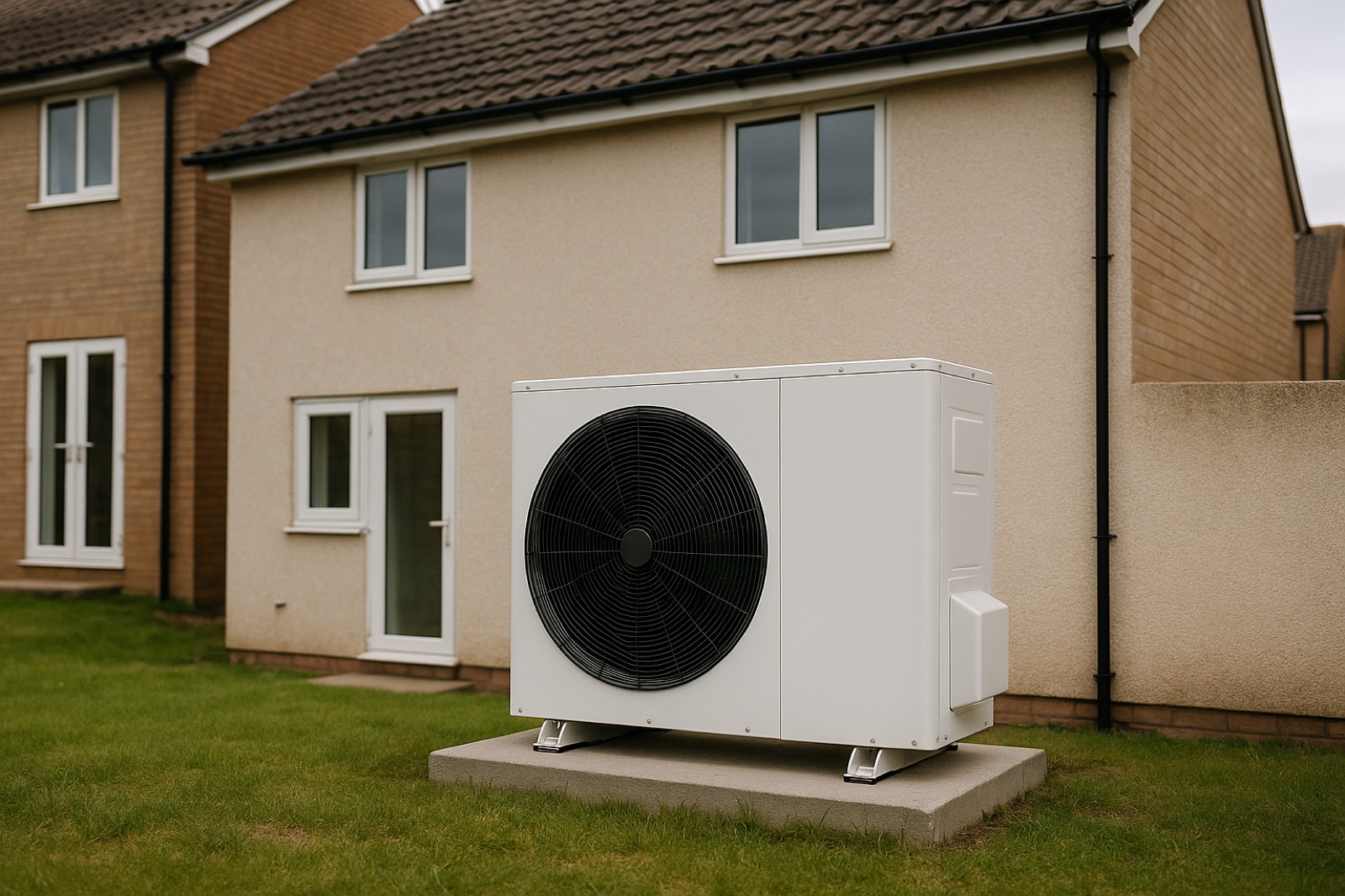
It is a box outside your house, usually against a back or side wall, with a large fan on the front. Pipes run from it into the house, where it heats the water that flows round your radiators or underfloor heating, and a hot water cylinder. This type is called “air to water”, and it is the kind most people mean, and the kind the main grant pays for.
There is also “air to air”, which blows warm air into rooms through indoor units, like reversible air conditioning. It doesn’t make hot water and gets a smaller grant. If you are weighing up air against a ground loop instead, our air source vs ground source guide covers that comparison.
How it works, step by step
If you have ever wondered how an air heat pump works when it’s cold outside, the answer is that air at 0°C still holds heat. The trick is a refrigerant that boils at a far lower temperature than water. The system runs in a loop, the same way your fridge does, only pointed the other way.
- Collect. The fan pulls outside air over a coil filled with cold liquid refrigerant. Even on a frosty day the air is warmer than the refrigerant, so heat flows into it and it boils into a gas.
- Squeeze. A compressor, which is the part that uses most of the electricity, squashes that gas. Compressing a gas makes it hotter, so a lukewarm gas becomes a hot one.
- Release. The hot gas passes through a heat exchanger and hands its heat to your heating water. As it cools, it turns back into a liquid.
- Reset. The liquid goes through an expansion valve, which drops its pressure and temperature, and the loop starts again.
Your electricity bill pays for the fan, the compressor and the pumps. The heat itself comes from the air for free. That is the whole point.
COP and SCOP: the number that matters
COP (coefficient of performance) is heat out divided by electricity in at a given moment. A COP of 3 means 3 kWh of heat for every 1 kWh you pay for. It changes all the time: higher on a mild day, lower on a freezing one, and lower again if the system has to send very hot water to the radiators.
SCOP (seasonal COP) is the average over a whole year, and it is the figure that sets your bill. The government-funded Electrification of Heat trial monitored 742 heat pumps in real homes. Air source units averaged 293% efficiency, roughly a SCOP of 2.9, against about 84% for a typical fossil fuel system. Which? says UK heat pumps generally achieve a SCOP of around 3.
Two common mistakes pull people in opposite directions. Sceptics use the coldest day’s COP as if it applied all year. Enthusiasts quote the brochure SCOP of 4 or more, which a well-designed system can reach, but which the average installation does not. The biggest thing that moves your SCOP is flow temperature: the cooler the water your radiators need, the harder the heat pump can work for you.
Is electricity really 3x gas? The sums
Yes, roughly. Under Ofgem’s price cap for 1 October to 31 December 2026, electricity is 26.32p per kWh and gas is 7.97p per kWh (Direct Debit, averaged across England, Scotland and Wales). That makes a unit of electricity about 3.3 times the price of a unit of gas. But you aren’t buying units of fuel. You are buying heat.
Here is the working for a typical home, using Ofgem’s typical gas use of 9,500 kWh a year:
- Heat the home actually needs: 9,500 kWh of gas × 85% boiler efficiency = 8,075 kWh of heat.
- Gas boiler: 9,500 kWh × 7.97p = £757, plus the gas standing charge of 29.68p a day (£108 a year) = about £865.
- Heat pump at SCOP 2.5 (a poor install): 8,075 ÷ 2.5 = 3,230 kWh × 26.32p = about £850.
- Heat pump at SCOP 2.9 (the trial average): 8,075 ÷ 2.9 = 2,784 kWh × 26.32p = about £733.
- Heat pump at SCOP 3.5 (a good install): 8,075 ÷ 3.5 = 2,307 kWh × 26.32p = about £607.
The break-even point is a SCOP of about 2.8 (3.3 × 0.85). Above that, you pay less for the heat itself. If you also close your gas account, you stop paying the gas standing charge, which is where much of the saving comes from for an average system.
Be wary of both extremes. The “3x” argument ignores efficiency. The “costs nothing to run” stories usually come from homes with solar panels, a battery or a heat pump tariff, which change the price per unit rather than the heat pump. Which? notes that a specialist tariff can make savings possible even at a lower SCOP, and that at standard rates the SCOP needs to be high enough to beat gas. Also note that VAT on electricity is zero from 1 October 2026 to 31 March 2027, so these sums may shift when it returns.
Hot water and the cylinder
An air source heat pump system heats your hot water as well as your radiators, but it can’t heat water instantly like a combi boiler. It heats a stored tank, so you need space for a hot water cylinder, usually in an airing cupboard or loft. If you had a combi and took the cylinder out, finding room for one is part of the job and part of the price.
You may also see an “air source heat pump water heater”, a cylinder with a small heat pump on top that only does hot water. That is a different product. It won’t heat your home, and grant rules are written for systems that cover your full space heating, so don’t expect the £7,500 for one.
Who it suits, and who it doesn’t
The most common worry is that heat pumps only work in new builds. The Electrification of Heat trial installed them across a range of house types and ages and concluded that all of them were suitable. Older homes lose heat faster, so they need a bigger unit and sometimes larger radiators, which affects cost. They don’t rule the house out.
A good fit if you:
- Own your home and plan to stay a while, so the grant and lower running costs have time to pay off.
- Are off the gas grid on oil, LPG or electric storage heaters. These cost more per unit of heat than gas, so the saving is bigger, and eligible off-gas homes get a £9,000 grant until 31 March 2027.
- Have room outside for the unit and inside for a cylinder.
- Are happy for the heating to run low and steady rather than blasting for an hour.
Think harder if you:
- Have just fitted a new A-rated gas boiler and are on a standard tariff. Your saving at average efficiency is small.
- Live in a flat with no outside wall or balcony space, or a leasehold where the freeholder must agree.
- Are in a listed building or conservation area, where you will probably need permission.
You don’t need underfloor heating, and you don’t need to insulate every wall first. Cheap fixes like loft insulation and draught-proofing reduce the size of heat pump you need, which lowers the price. Our grants guide covers help with insulation too.
Noise, space and planning
The outdoor unit hums when it runs, so its position matters if a neighbour’s window is close. In England, permitted development rules changed on 29 May 2025. You can now fit a unit within 1 metre of your boundary, the size limit rose from 0.6m³ to 1.5m³, and a detached house can have two units. The installation must pass the MCS 020(a) noise calculation to count as permitted development. Scotland and Wales have their own rules, so check with your council.
To get the Boiler Upgrade Scheme grant in England and Wales, your installer must be MCS certified. They apply for the grant for you, and it should come off your quote upfront.
Questions people ask
Does an air source heat pump work below freezing?
Yes. There is still heat in the air well below zero. Efficiency falls on the coldest days, which is why your annual SCOP, not the worst-day COP, is the figure to use for bills. The installer sizes the unit for your local winter design temperature.
Should I leave it on all the time?
Usually it works best running steadily at a low flow temperature, rather than switching off and reheating a cold house. Ask your installer how they have set the controls and weather compensation, and why.
Will I need new radiators?
Possibly in some rooms. Because a heat pump sends cooler water round the system, a room that loses a lot of heat may need a larger radiator. A room-by-room heat loss survey shows which ones. See our central heating guides for more on radiators.
Can I get a grant in Scotland?
The Boiler Upgrade Scheme covers England and Wales. In Scotland, Home Energy Scotland offers a grant of up to £7,500 for a heat pump, with an optional interest-free loan of up to £7,500 on top.
Sources
- Ofgem: changes to the energy price cap, 1 October to 31 December 2026
- Ofgem: price cap update and revised typical consumption values, 1 July 2026
- Ofgem: Boiler Upgrade Scheme
- DESNZ: Boiler Upgrade Scheme statistics, August 2026 (table Q1.1A)
- ACR News: Electrification of Heat demonstration final report findings
- Which?: air source heat pump costs and savings
- MCS: new permitted development rules in England and MCS 020(a)
- MCS: Boiler Upgrade Scheme for consumers
- CIBSE Journal: Boiler Upgrade Scheme eligibility and hot-water-only heat pumps
- Home Energy Scotland: grant and loan