Home Damp and mould removal Guide
Removing mould from walls, and stopping it coming back
Black mould wipes off easily enough. Keeping it off is the hard part. Here is how to clean it safely, and why it keeps returning when you only treat the stain.
You scrub the black patch off the bedroom wall, and three weeks later it’s back in the same corner. That pattern is the most common complaint about mould, and it has a simple explanation. To remove mould from walls for good you have to do two jobs: clean off what’s there safely, then take away the damp that let it grow. This guide covers both.
At a glance
| Option | Good for | The catch |
|---|---|---|
| Washing-up liquid and warm water | Small patches on hard, painted surfaces | Needs repeating if the damp stays |
| Mould and mildew remover | Small areas; government guidance prefers these to bleach | Follow the label, ventilate, wear PPE |
| Bleach | Hard, non-porous surfaces only | Removes the colour on plaster but not mould deep in the material; fumes |
| White vinegar | Light patches | Doesn’t fix the moisture behind the mould |
| Professional help | Patches over about 1m², several rooms, or vulnerable people at home | Costs more, but finds the cause |
Before you start: is it safe to do yourself?
Mould isn’t just ugly. Government guidance on damp and mould, written with the UK Health Security Agency, says it mainly affects the airways and lungs, causing coughing, wheezing and shortness of breath, and can make asthma worse. It can also irritate the eyes and skin.
Some people are more at risk, and shouldn’t be the ones doing the cleaning. That includes children, older people, pregnant women, anyone with asthma, COPD or another lung condition, and anyone with a weakened immune system, for example during chemotherapy.
Get professional help rather than tackling it yourself if:
- the mould covers a large area. The US Environmental Protection Agency puts the DIY limit at about 10 square feet, roughly 1m²
- it’s in more than one room or keeps coming back fast
- it followed a flood, a leak or sewage
- removing it means pulling off wallpaper, plasterboard, carpet or ceiling materials
- you or someone you live with is in one of the higher-risk groups
How to remove mould from walls
For a small patch on a painted or hard wall, follow these steps.
- Take photos first. Useful if you rent, or if you need to show a surveyor how big it was.
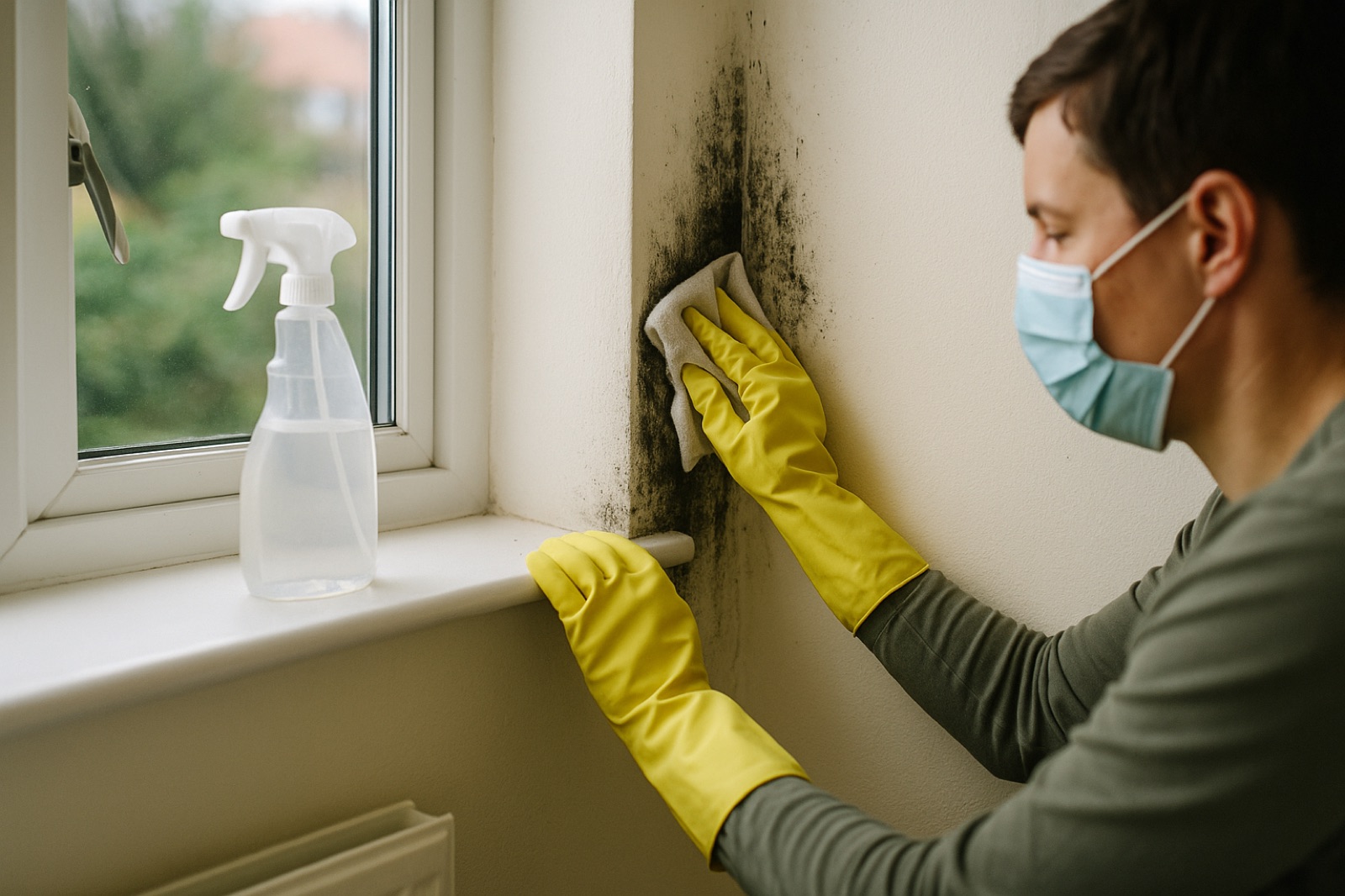
- Protect yourself. Wear rubber or chemical-resistant gloves, goggles without vent holes, and a mask that covers your nose and mouth. A well-fitting FFP2 or FFP3 mask reduces how many spores you breathe in.
- Ventilate, and contain. Open the window in the room and keep the door shut so spores don’t spread to the rest of the house.
- Pick one cleaner. Start with a few drops of washing-up liquid in warm water, or a purpose-made mould and mildew remover. Check it suits the surface. Use only one product at a time.
- Scrub gently, then rinse. Work on the patch with a damp cloth rather than attacking it hard, and rinse with clean water.
- Follow the product label. Removers need time on the surface to kill the mould rather than just bleach out the stain.
- Dry the area completely. Mould needs moisture. A wet wall after cleaning is a head start for regrowth.
- Bag and bin the cloths. Wash or throw away your gloves and mask afterwards too.
Mould on soft things such as carpet, curtains, mattresses or ceiling tiles is harder. Both UK and US guidance say badly affected absorbent materials may need to be thrown away, because the mould gets into the fibres.
Don’t paint straight over mould. The EPA warns that paint applied over mould tends to peel. Clean and dry the wall first, then a mould-resistant paint can help, as Which? suggests.
Can bleach kill mould? And vinegar?
Bleach is the first thing most people reach for, and the main reason for disappointment. Sodium hypochlorite, the active ingredient in many black mould removers, can kill surface mould on hard, non-porous surfaces such as tiles and glass. Plaster and plasterboard are porous. Bleach whitens the black staining you can see, but it can’t reliably remove mould that has grown into the material, so the patch returns.
There’s a safety reason to avoid it too. The government’s damp and mould guidance says mould and mildew products should be used in preference to bleach, for health and safety reasons. Bleach fumes can irritate your eyes, skin and airways, and they’re worse in a small, closed room.
Never mix bleach with other cleaners. Mixed with products containing ammonia, it can release toxic gas. If one product hasn’t worked, rinse the area well and let it dry before you try another.
Vinegar gets a lot of praise online. Which? suggests a 1:1 mix of white vinegar and warm water, left on for up to an hour, for smaller patches. It’s a reasonable mild option, but like bleach it treats the surface. Neither does anything about the moisture that grew the mould.
The same goes for damp traps and crystal pots. They absorb only small amounts of water, so they can’t stop mould on a wall that gets wet every night. Which? says even an electric dehumidifier won’t get rid of existing mould, though it can help stop it spreading or forming.
Why mould keeps coming back
Mould grows where a surface stays damp. In most homes that damp is condensation: moisture from cooking, showers, drying clothes and breathing settles on the coldest surfaces, such as outside walls, wall corners and window frames. Clean the wall but leave the moisture, and the spores that are always in the air will settle and grow again.
To stop the regrowth, change the conditions:
- Get moisture out. Use the extractor fans in the kitchen and bathroom, cover pans, and open a window after showering. Keep trickle vents open. If you have no extractor fan or it barely pulls, look at better ventilation.
- Keep rooms warm. Which? recommends heating cold rooms to at least a low level. Cold walls collect condensation.
- Dry washing in one ventilated room, or outside, not on radiators around the house.
- Pull furniture away from outside walls so air can move behind it.
- Check the humidity. The EPA advises keeping it below 60%, ideally 30% to 50%. A dehumidifier helps if you can’t get it down another way.
If the mould is in one patch, appears after rain, or comes back despite good ventilation and heating, the cause may be a leak or penetrating damp. Cleaning won’t fix that. Our damp and mould hub explains the different types of damp and how to tell them apart.
If you rent
Being told it’s your “lifestyle” is a common experience. Government guidance for landlords is clear that it is “totally unreasonable” to blame damp and mould on lifestyle choices. The usual causes are building problems, poor ventilation, inadequate heating and poor energy efficiency.
In England, Awaab’s Law has applied to social landlords (councils and housing associations) since 27 October 2025. For significant damp and mould, your landlord must investigate within 10 working days of you reporting it, send you a written summary within 3 working days of the investigation, and make the home safe within 5 working days. Emergency hazards must be made safe within 24 hours. If the home can’t be made safe in time, the landlord must offer you somewhere suitable to stay.
The government has committed to extending Awaab’s Law to private renting through the Renters’ Rights Act, but at the time of writing no start date has been confirmed. Private landlords must still keep homes fit to live in. Report mould in writing, with photos, and contact your council’s environmental health team if nothing happens.
Questions people ask
What is the best black mould remover?
For small patches, a purpose-made mould and mildew remover suited to the surface, used as the label says. Government guidance prefers these to bleach. No product stops mould returning if the wall stays damp.
Is black mould dangerous?
Mould can cause breathing problems, make asthma worse and irritate eyes and skin. Children, older people and anyone with a lung condition or weak immune system are most at risk, so act on it quickly.
Can I just paint over mould?
No. Paint over mould tends to peel and the mould keeps growing underneath. Clean and dry the wall first, then use a mould-resistant paint if you like.
Will a dehumidifier get rid of mould?
Not on its own. It won’t remove mould that’s already there, but by lowering humidity it can help stop new mould forming after you’ve cleaned.
Sources
- GOV.UK / UKHSA: Understanding and addressing the health risks of damp and mould in the home
- US EPA: A brief guide to mold, moisture and your home
- Aspergillosis Patients & Carers Support: Removing mould from your home
- Which?: How to get rid of mould
- Which?: How to stop condensation
- GOV.UK: Awaab’s Law, guidance for tenants in social housing
- GOV.UK: Millions of tenants safe from black mould through Awaab’s Law