Home Heating engineers Guide
How to bleed a radiator
A radiator that’s cold at the top has air trapped inside. Letting it out takes a few minutes and a radiator key. The step people forget is checking the boiler pressure afterwards.
If you want to know how to bleed a radiator, the short version is this: turn the heating off, open the small valve at the top corner with a radiator key until the hissing stops and water appears, then close it. On most modern homes with a combi or system boiler, you then need to check the pressure gauge, because letting air out also lowers the pressure in the system.
At a glance
| What to expect | |
|---|---|
| Time | A few minutes per radiator, plus time for the system to cool |
| Tools | Radiator key (or a flat screwdriver on some valves), cloth, small container |
| Heating on or off? | Off, and let the radiators cool first |
| Boiler pressure with heating off | Usually 1 to 1.5 bar |
| Boiler pressure with heating on | Around 2 bar |
| How often | Every few months, and after the heating has been off for the summer |
Signs a radiator needs bleeding
Air collects at the highest point inside a radiator. It takes up space the hot water should fill, so the top stays cool while the bottom gets hot. British Gas lists three signs to look for:
- The radiator is cold at the top but warm at the bottom.
- You hear gurgling or bubbling from the radiator or pipes.
- The radiator doesn’t warm up at all.
If the radiator is cold at the bottom and warm at the top, air isn’t the problem. That pattern usually points to sludge, which bleeding won’t fix. More on that below.
What you need
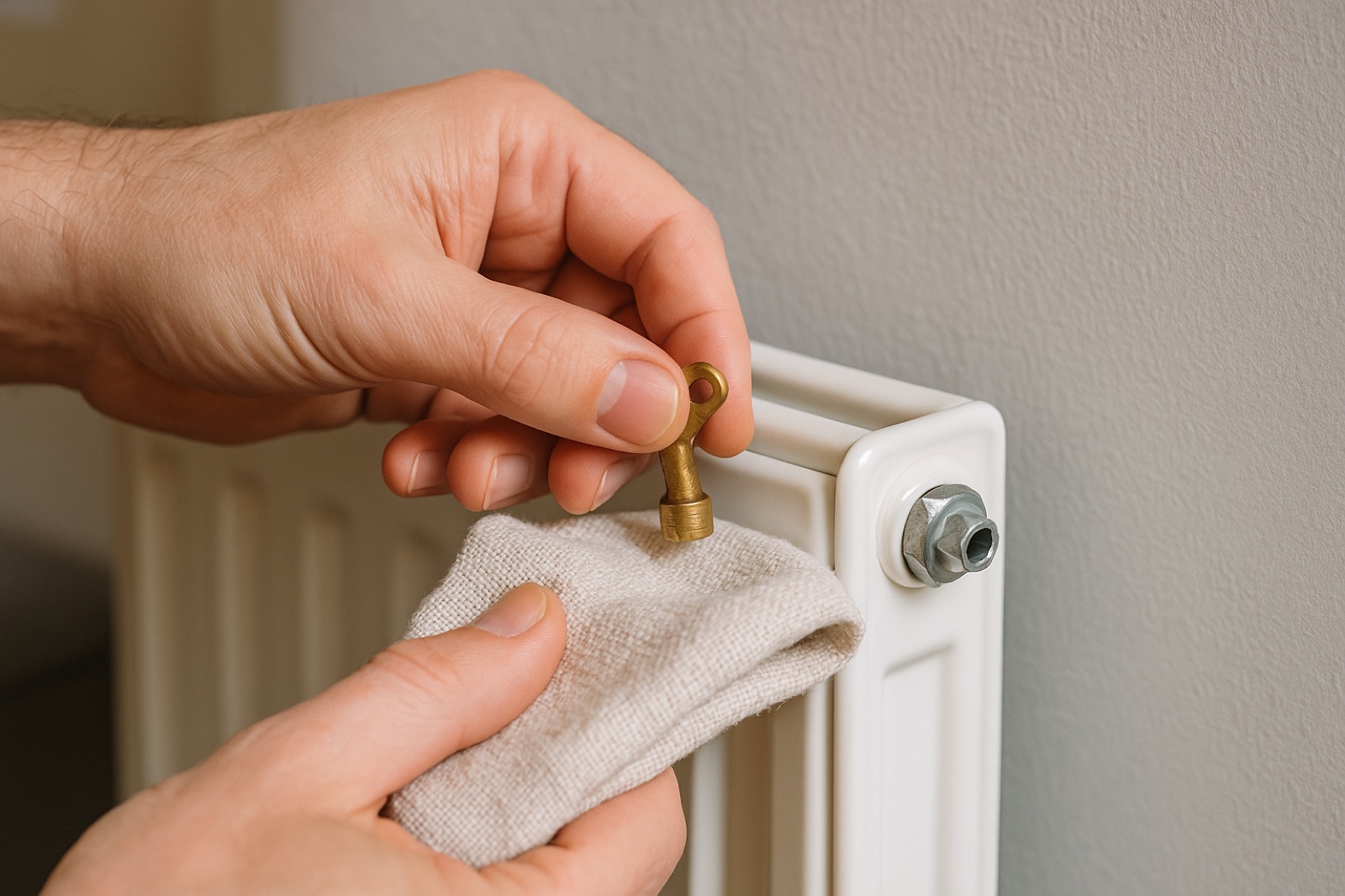
A radiator key is a small brass or steel key with a square socket that fits the bleed valve. They cost a couple of pounds from any DIY shop or supermarket, and it’s worth keeping two in a kitchen drawer. Some newer radiators have a slotted bleeder that turns with a flat-head screwdriver instead.
You also want an old towel or cloth to catch drips, and a small cup or container. The water inside a heating system is often dark and can stain carpets.
How to bleed a radiator, step by step
- Find the cold radiators. Turn the heating on and carefully feel the top of each radiator. Note which ones are cool at the top or gurgling. Baxi suggests checking the highest radiator in the house first, often a heated towel rail in the bathroom, because air tends to gather there.
- Check the boiler pressure. Look at the gauge on the front of the boiler, or underneath it on some older models, and note the reading. You’ll compare it at the end.
- Turn the heating off and let it cool. Never bleed a hot radiator. The water can scald, and a running pump can pull more air into the system.
- Get ready at the valve. The bleed valve is the small square fitting at one of the top corners. Hold the cloth under it and fit the radiator key.
- Open it slowly. Turn the key anticlockwise, about a quarter turn is usually enough. You should hear air hissing out. Don’t unscrew it all the way.
- Close it when water appears. Once the hissing stops and a steady trickle of water comes out, turn the key clockwise to close the valve. Tighten it firmly, but don’t force it.
- Repeat on the other radiators that needed bleeding, wiping up any drips as you go.
- Check the boiler pressure again. It will usually have dropped a little. If it’s below the normal range, top it up as described in the next section.
- Turn the heating back on and feel the radiators once they’ve warmed up. They should now be hot across the whole panel.
Re-pressurising a combi after bleeding
Combi and system boilers run on a sealed system that holds water under pressure. When you let air out, a little water follows it, and the pressure drops. If you bleed several radiators, it can drop far enough for the boiler to lock out with a low-pressure fault.
British Gas says to aim for 1 to 1.5 bar on the gauge with the boiler off. Ideal, Vaillant and Worcester Bosch all give the same 1 to 1.5 bar as the level to fill to. Below 1 bar, Ideal says the boiler may show a fault and stop working until you top it up.
Topping up is a job you can safely do yourself, using the filling loop. Here’s how:
- Switch the boiler off and let the system cool.
- Find the filling controls under the boiler. This is usually a flexible silver hose with a valve or tap at each end. Some Worcester Bosch combis have a blue lever you pull down instead, and others use a plastic key that slots into the underside. Your boiler’s user manual shows which you have.
- Open the valve or valves slowly and watch the gauge. You’ll hear water flowing in.
- Close the valves once the needle reaches between 1 and 1.5 bar. Make sure they’re fully shut.
- Switch the boiler back on. If it shows a fault code, press reset as your manual describes.
Only operate controls you can clearly identify, and don’t remove the boiler casing. If your loop is missing or you can’t find it, ask an engineer. Our guide to boilers explains the different types if you’re not sure what you have.
If you’ve overshot and the gauge reads above 2 bar when cold, bleed a radiator again to let a little water out, catching it in your container, and recheck.
Older open-vented systems, with a small tank in the loft feeding the heating, don’t have a pressure gauge or filling loop. The tank tops the system up by itself, so after bleeding there’s nothing more to do.
If the radiator is still cold
If you’ve bled a radiator and it’s still cold, check these before calling someone:
- Both valves are open. The valve at each bottom corner should be open. A thermostatic valve set to 0 or * will keep the radiator off.
- The pressure is in range. A boiler with low pressure may not heat anything.
- Cold at the bottom, warm at the top. This usually means sludge has settled inside. Baxi advises that a Gas Safe registered engineer can flush the system and add inhibitor to protect it.
- Some rooms always heat slower. The system may need balancing so water reaches the far radiators. Read more in our central heating guides.
Stop and call a Gas Safe registered engineer if a bleed valve won’t close or keeps leaking, if you need to top up the pressure often, or if you see water dripping from pipes, joints or the boiler.
Questions people ask
Should the heating be on or off when I bleed a radiator?
Off. Turn it on first to find the cold radiators, then switch it off and let them cool before you open any valve. Hot water can scald, and a running pump can draw air back in.
Which radiator should I bleed first?
Air tends to collect in the highest radiator, so Baxi suggests starting with that one. In many homes it’s the heated towel rail in an upstairs bathroom.
Why has my boiler pressure dropped after I bled the radiators?
Some water escapes with the air, which lowers the pressure in a sealed system. That’s normal. Top it back up to between 1 and 1.5 bar with the filling loop.
How often should I bleed my radiators?
British Gas suggests every few months, and after a long period without use, such as when you turn the heating back on after summer. If one radiator needs bleeding every week, the system may be drawing in air or have a leak, so get it checked.
I’ve lost my radiator key. What can I use?
Buy a replacement. They’re cheap and widely sold. Pliers can round off the square valve head and make it hard to open or close later.