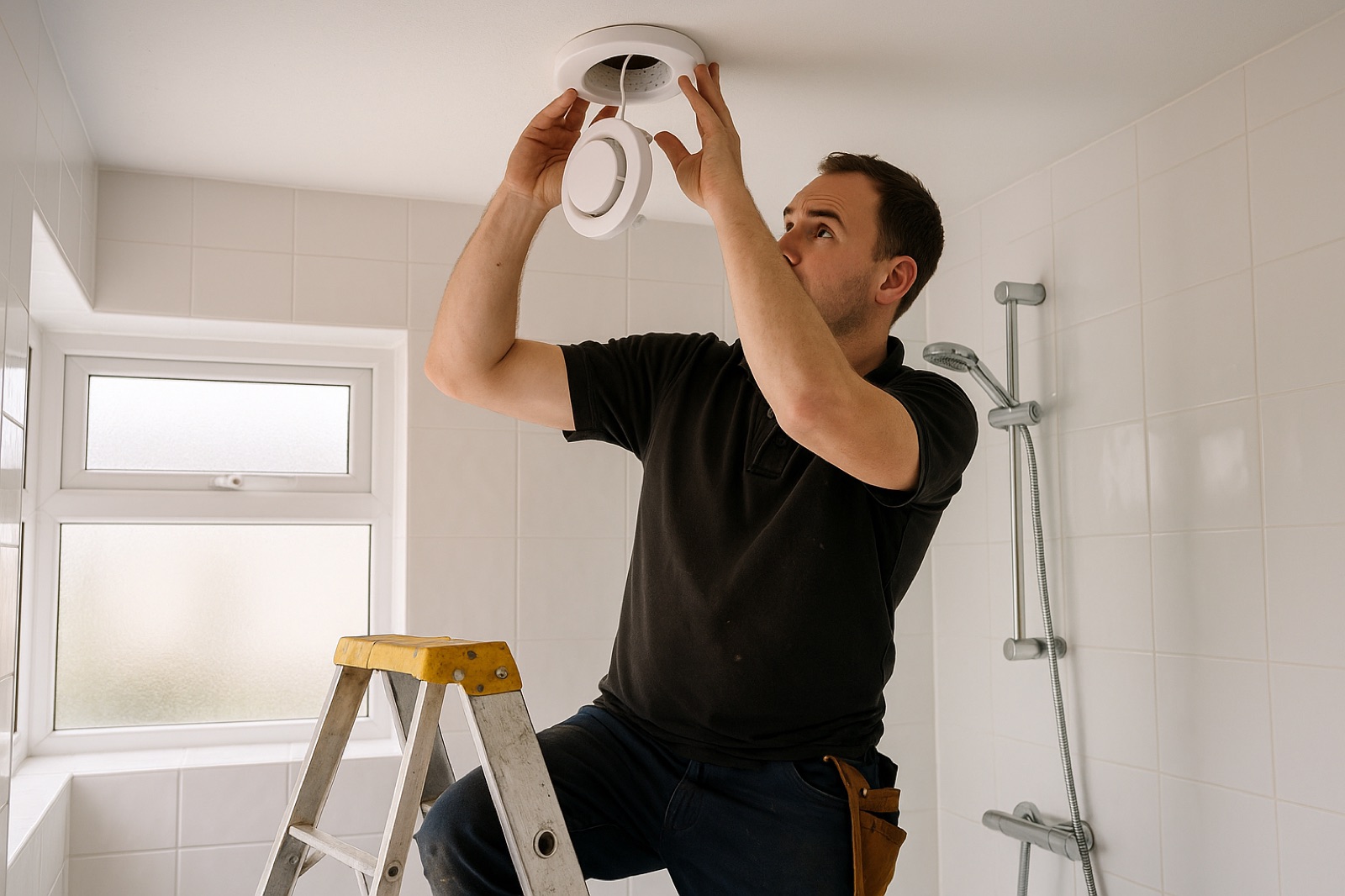
Home Ventilation installation Swansea
Ventilation installation in Swansea
From a quiet bathroom fan to whole-house heat recovery, get ventilation that stops condensation at the source.
Many Swansea homes are about to get warmer and tighter. With 62% of homes with an EPC rated D or below, insulation is the first step under Nest and other schemes. But sealing a house without improving ventilation often swaps cold draughts for condensation and mould.
Swansea at a glance
- Housing mix
- 34.5% of Swansea households lived in semi-detached houses in 2021, 25.4% in terraces and 24.0% in detached houses. Flats, maisonettes and apartments made up 15.9%. Source
- Energy ratings
- Only 38.0% of Swansea homes with an EPC lodged up to March 2022 were rated C or above, below Cardiff's 47.5%. For terraced houses the figure was 25.9%, and for homes built before 1930 it was 13.2%. Source
Start with the wet rooms
Bathrooms and kitchens produce most of a home's moisture. A bathroom fan should run on after you leave and boost when humidity rises. Many fitted fans are too small, noisy or wired to the light only, so they rarely run long enough.
Ducted cooker hoods that vent outside are much better than recirculating ones at removing steam.
Whole-house options
Positive input ventilation (PIV) pushes filtered air from the loft into the hallway. It works best in houses with a loft and an open stairwell, which suits many Swansea semis.
Mechanical ventilation with heat recovery (MVHR) is the best choice in an airtight house, such as after external wall insulation. It needs ductwork to every room, so plan it with the insulation work.
Insulation and ventilation together
If an installer is filling cavity walls or fitting new windows, ask how the house will be ventilated afterwards. Trickle vents in new windows should be kept, and fans should be checked.
Under Nest, a whole-house assessment comes before any work. Ventilation should be part of that plan.
Who fits what
An electrician can fit or replace extractor fans and PIV units. MVHR should be designed by someone who sizes the ducts and balances the airflows to each room, then commissioned and documented. Ask for the commissioning sheet when the work is finished.
Swansea homes and what they need
Hillside Victorian and Edwardian terraces
Rear rooms set into the hillside can be damp and poorly ventilated. A continuous extract fan in the back kitchen or bathroom and clear air bricks help.
Interwar and post-war semis
PIV in the loft and a good bathroom fan cover most needs. Check loft insulation doesn't block the eaves vents.
Waterfront and city-centre flats
Newer flats may have MVHR already. Find out where the unit is, check the filters and make sure it hasn't been switched off.
Areas covered
Engineers who cover Swansea work across areas including Sketty, Uplands, Mumbles, Killay, Morriston, Townhill, Brynmill, Gorseinon, Pontarddulais and Clydach.
Questions people in Swansea ask
Will a PIV unit stop mould in my Swansea semi?
It reduces condensation, which is the usual cause. It won't fix rain penetration or a leak, so rule those out first.
Do landlords in Wales have to provide ventilation?
Landlords must keep homes fit to live in, and damp and mould are part of that test. Broken extractor fans should be reported as a repair.
Sources
- ONS: Energy efficiency of housing, local authority districts
- Welsh Government: Nest
- Welsh Government: Fitness for human habitation, guidance for contract-holders
Also nearby: Ventilation installation in Cardiff